How can the industry work
together to ensure the longevity
of the UK’s independent presses?
Sign the Open Letter
Join the Round Table
Mailing List
Contact Small Press Futures
Our Team
Events
An Open Letter / A Round Table.
As leading UK indie publishers, we come together to raise awareness of the economic realities of our sector and what is at stake if we are unable to continue. The UK is home to a rich landscape of independent publishers who take risks on books that have been ignored by the wider industry, launch careers and spark stylistic innovation. We have published titles that have been shortlisted for, or have won, many of the major prizes (the Booker and International Booker Prizes, The Women’s Prize, the Folio Prize, the Goldsmith’s Prize, the Gordon Burn Prize, the James Tait Black Memorial Prize, Desmond Elliot, Republic of Consciousness and more).
Many of us offer open submission windows, nurture new writing talent and make the industry more accessible to authors from under-represented communities. We develop close relationships with independent booksellers, enrich readers’ experience through events and community engagement, and stand elbow-to-elbow with larger publishers to bring innovative and diverse literature to wide audiences.



Collectively, our authors and translators enhance UK publishing’s bibliodiversity by supporting writers of colour, queer and trans, working-class and intersectional authors, alongside translations from languages less-represented in Anglophone markets. Inflation, war and cuts to national arts funding have increased the challenges faced by independent publishers and we are now confronting an existential crisis that will determine the trajectory of literary publishing in the UK. As follows is a summary of the key challenges that we are facing.
Inflation
The war in Ukraine has affected paper supply and energy costs, significantly increasing our expenditure. Ukraine was responsible for a large amount of the paper pulp used in the UK, and interruptions to supply have caused huge jumps in costs. The combination of custom fees caused by Brexit, and now Trump’s trade tariffs, have caused fulfilment issues for our two largest foreign markets: Europe and the US. Due to complicated and uncertain tax arrangements, we are losing customers and subscribers, with a huge knock-on effect on sales income. Austerity and the cost-of-living crisis has put pressure on indies to increase freelancer wages, though our own salaries have stagnated, while we are simultaneously pressured to keep our book prices low.
Production issues
The cost of producing a book has more than doubled in the past 10 years. The unit cost of printing and producing a title in 2015 was somewhere between £1.30 to £1.80. By 2023, that unit cost rose to somewhere between £2.83 to £3.50, an increase of 40 to 100%. As these costs continue to soar, the RRP of a book remains generally static, in part due to high print runs from Big Five publishers which allow them to keep costs low. With distribution and bookshop discounts on top of these rising costs, our already small margins are shrinking further.
Sales and Distribution
The retail landscape is data-driven and risk-averse, leaving less room for indie publishers in major retail shops. Dominant online retailers offering next-day delivery, alongside competitive practices by corporate booksellers which drive down prices, make it impossible to compete with customer expectations around shipping and cover prices. The lack of review coverage and the rapidly shrinking space in national media outlets makes it hard for a book to “sell in” to bookshops and then “break out” to wider success. There has been a reduction in the number of distributors available for small stock and low turnovers. Storage and distribution will cost publishers a minimum of 25% of the net value of sales, while larger distributors will only take on publishers with turnovers over £1m.
Funding
Both Tory and Labour governments have significantly cut funding for the arts, severely impacting the sector. UK independent presses have largely relied on government funding, particularly Arts Council England’s (ACE) National Lottery Project Grants (NLPG) and National Portfolio Organisation (NPO) grant programmes, the latter of which is the only grant programme to offer multi-year core funding. In 2024 and 2025, ACE delayed any new applications for NPO funding, which means that any new grantees won’t receive funding until 2028. Most recently, ACE’s application portal, Grantium, malfunctioned, delaying any new NLPG project applicants for weeks. Given the time it can take to write an ACE NLPG bid, and the waiting times to hear back, a month without access to apply was a further setback for many small presses.
Similarly, many Scottish publishers rely upon Creative Scotland’s (CS) Open Project Funding (OPF) while no publishers are supported by their Multi-Year Funding (MYF) route. 2024 also saw tumultuous arts budget cuts and U-turns from the Scottish government, forcing CS to temporarily close OPF applications and delay MYF funding decisions until 2025.
We are also seeing the impact of ACE’s “Let’s Create” strategy outcomes, which have admirable aims, but make it significantly more difficult than the previous “Great Art for Everyone” strategy for small presses to access funding to publish books. As a result, it has become more challenging to secure smaller individual grants to support our ongoing work and to cover the core costs involved in publishing our books. Many small presses are running on the ‘potential’ of funding, which is an unsustainable operational model. Without investors or guaranteed grant funding, there is no sustainable future.
Many independent publishers have spoken out in support of Palestine, and taken a stand for BDS (Boycott, Divestment, Sanctions) and PACBI (Palestinian Campaign for the Academic and Cultural Boycott of Israel). This has on occasion had a direct impact on funding outcomes. The leadership of independent presses on this issue is taking place in an environment of increasing state censorship of Palestine solidarity and repression of Palestinian artists. Publishers supporting Palestine risk malicious attacks to reputation and cyber security—a significant drain on resources. As a result, independent presses are hit harder for standing with our Palestinian authors and colleagues and for our commitment to social justice.
This accumulation of pressure has created unsustainable workloads and increasingly uncertain prospects, significantly impacting our well-being and capacity to manage these workloads. Independent publishers face limited cashflow and inconsistent labour, yet the industry often holds us to the same standards as the Big Five publishers.
These challenges are already having a measurable impact: recent years have seen the closure of numerous indie publishers including Henningham Family Press, Red Dog Press, Bearded Badger Press, Handheld Press, Wrecking Ball Press and Sandstone Press, while 404 Ink has announced their intention to close in mid-2026 as they wind down operations. If we do not enact change now, there is a real possibility that many indie presses will be unable to continue operating in the next five years, indefinitely altering the breadth and diversity of the UK’s literary landscape.
Following the publication of
this letter, we will be inviting
key stakeholders from across
the industry to come together
to discuss how we imagine, and
action, a sustainable future for
independent presses, and the
writers and translators we
publish.
this letter, we will be inviting
key stakeholders from across
the industry to come together
to discuss how we imagine, and
action, a sustainable future for
independent presses, and the
writers and translators we
publish.


If you are a small press
publisher and would like
to co-sign, please fill in
the form below or address
enquiries to the following
address ...
Sign the Open Letter
uksmallpressfutures@prototypepublishing.co.uk
The list of signatories
is updated weekly.
Publisher Directory / Signatories
( a / z. )
404 Ink / 404ink.com/
Afsana Press afsana-press.com/
Bad Betty Press / badbettypress.com/
Bluemoose / bluemoosebooks.com/
Book Works / bookworks.org.uk/
Bricks from the Kiln / b-f-t-k.info/
Broken Sleep Books / brokensleepbooks.com/
Carcazan Publishing / carcazan.com/
Cipher Press / cipherpress.co.uk/
Common Threads / commonthreadspress.co.uk/
Confingo Publishing / confingopublishing.uk/
The Emma Press / theemmapress.com/
Epoque Press / epoquepress.com/
Galley Beggar / galleybeggar.co.uk/
Guillemot Press / guillemotpress.co.uk/
Héloïse Press / heloisepress.com/
Hem Press / hempressbooks.com/
Hajar Press / hajarpress.com/
Hazel Press / hazelpress.co.uk/
House Sparrow Press / housesparrowpress.com/
Inkandescent / inkandescent.co.uk/
Influx Press / influxpress.com/
Joan / joanpublishing.org/
Lolli Editions / lollieditions.com/
Lurid Editions / lurideditions.com/
Ma Bibliothèque / mabibliotheque.cargo.site/
Makina Books / makinabooks.com/
Monitor Books / monitorbooks.co.uk/
Naked Figleaf Press nakedfigleafpress.com/
Nightjar Press / nightjarpress.weebly.com/
Osmosis Press / osmosispress.com/
Outspoken / outspokenldn.com/press
Palewell Press / palewellpress.co.uk/
Pamenar Press / pamenarpress.com/
Peninsula Press / peninsulapress.co.uk/
Poetry Salzburg / poetrysalzburg.com/
The Poetry Translation Centre / poetrytranslation.org
Praspar / praspar.com/
Prototype / prototypepublishing.co.uk/
Radical Bookshop & Press / radicalbookshop.co.uk/
Rough Trade Books / roughtradebooks.com/
Saqi Books / saqibooks.com/
Silver Press / silverpress.org/
Sold-Out Publishing / sold-out.net/
SRL Publishing / srlpublishing.co.uk/
Strange Attractor / strangeattractor.co.uk
Strange Region / strangeregion.com/
Tenement Press / tenementpress.com/
the87press / the87press.co.uk/
Tilted Axis Press / tiltedaxispress.com/
Verve Books / vervebooks.co.uk/
Vignette Editions / vignette-editions.com/
Weatherglass / weatherglassbooks.com/


Press & Coverage
Lucy Mercer & Livia Franchini
(Too Little / Too Hard), LitHub
‘Life-Giving, Imaginative and Underfunded:
Small Press Publishers in Crisis’
In conversation with
Jack Thompson
Jess Chander,
Sam Fisher
& Kristen Vida Alfaro.
( 04.12.25 )
[...]
[Our] ability to take risks and to publish books that would struggle to find a home with bigger publishers, is our strength, and in many ways the reason we exist; I think, fundamentally, this is why we believe the survival of small publishers matters. Without the existence of publishers able and willing to take risks, the literary ecology would be a lot more homogenous and closed-off.
See here.
Melina Spanoudi, The Bookseller
‘Indies aim for Cultural Impact Study
amid ‘challenging economic backdrop,’
FutureBook hears’
( 02.12.25 )
[...]
Small presses are seeking funding for a cultural impact study demonstrating the impact of indie presses, The Bookseller’s FutureBook conference heard on Monday 1st December.
The idea was outlined during a panel on the crisis faced by indie presses, chaired by writer and editor Lucy Mercer. Peninsula Press publisher Samuel Fisher said the study was inspired by the Booksellers Association’s report on the crucial role of indie bookshops in the UK’s cultural landscape. [...] The BA’s research has been an “incredibly powerful tool for lobbying,” according to Fisher, who said it provided central government with “hard numbers to digest in terms of the impact of bookshops.” Publishers are developing a similar document reflecting the work of indie presses.
“We we wanted to get together and say, what are the problems?,” Fisher said. “Start to think of some solutions, and then perhaps work together with other people in this industry who are minded to think on it as well.”
Indie presses will also host a series of events throughout 2026, in collaboration with journals and universities, to address different aspects of the letter. “It’s not about complaining, it’s about action,” said Kristen Vida Alfaro, director of Tilted Axis Press. “What can we do to make this more sustainable, so that we still exist?”
See here. ( Paywalled )
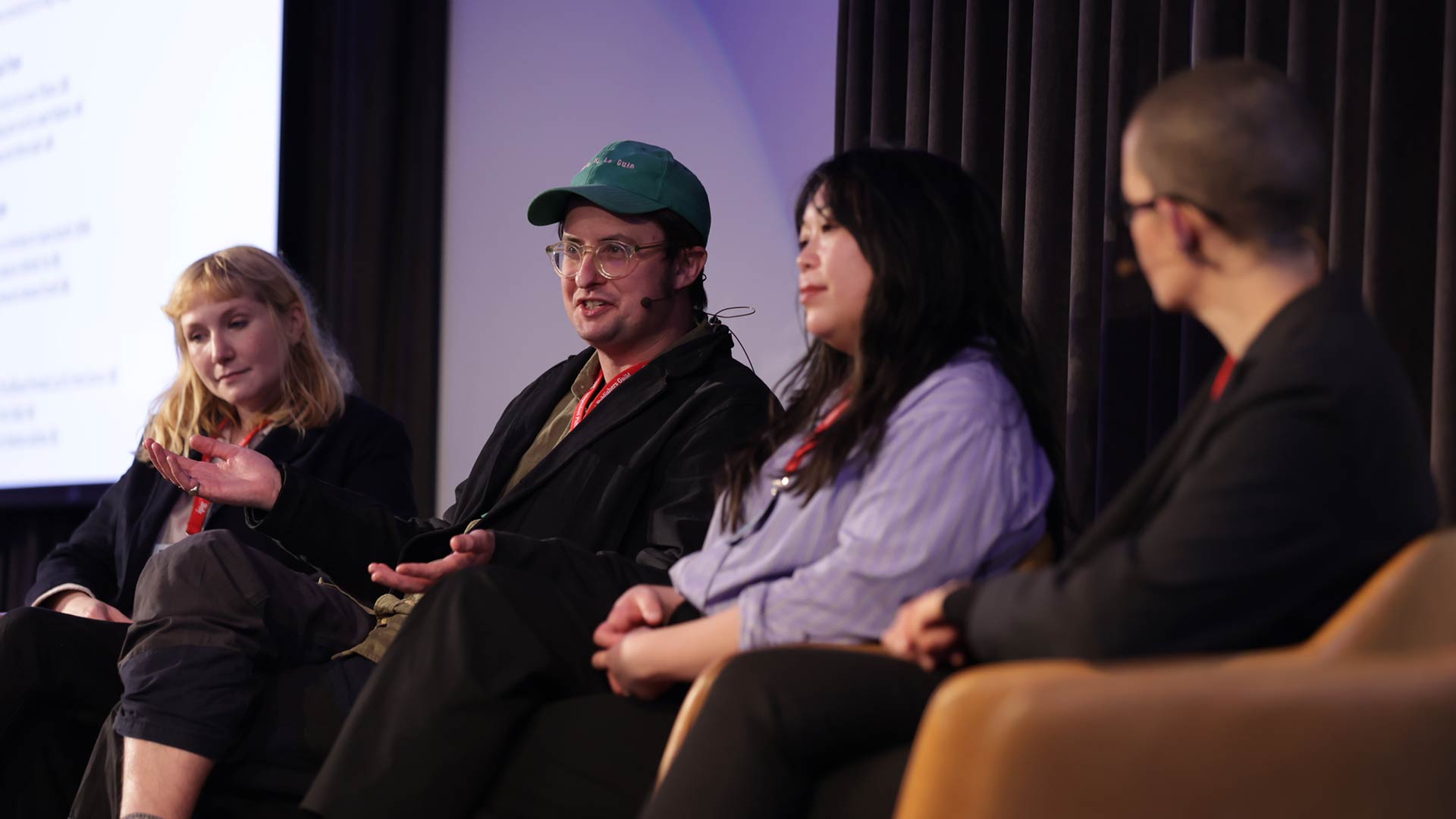 ( Left to Right ) Lucy Mercer, Sam Fisher, Kristen Vida Alfaro,
 & Jess Chandler at FutureBook (01.12.25).
Lucy Mercer, The Bookseller
‘Don’t Invest in AI, Invest in the Future of the Book’
( 18.11.25 )
[...]
Small-press publishers’ passion for and understanding of literature, combined with the creative, diverse and alternative perspectives and spaces that they provide through their books, means that like an underground river they are a source of deep life for the literary industry. However, they are facing a severe crisis that is now draining them dry, down to the riverbed. On top of the lack of pay, which has always been unsustainable, the increasing scarcity of public funding combined with the ongoing impacts of the collapse of the Net Book Agreement, the reign of Amazon, and now the rising costs of book production are leading them to a critical tipping point.
[...]
See here.
Micheal Caines, The Times Literary Supplement
NB . ‘Microaggressions’
( 17.10.25 )
Times are tough for small presses. The newspapers do not readily yield up much space for reviews of their books; state funding is hard to come by. Or so we read in the archives of the Bookseller, which provides a chronicle of small presses’ struggles in recent decades—the difficulties cited above refer to news items from 2003 and 2008, respectively—accompanied by much harmonious trumpeting of their achievements.
Before concluding that things were ever thus, however, consider a letter published in the Bookseller’s most recent issue. Twenty-three signatories, representing small presses in the UK such as Bluemoose, Galley Beggar, Rough Trade and the87press, here spell out the full awfulness of the current situation. The cost of book production has doubled in the past decade, not helped by interruptions to paper supply since the invasion of Ukraine (a major supplier of paper pulp to the UK). Storage and distribution cost publishers a “mimimum of 25% of the net value of sales,” and larger distributors “will only take on publishers with a minimum of over a million pounds.” As for funding: you might as well, for now, forget about it. The strategy implemented by Arts Council England five years ago, “Let’s Create,” seems peculiarly averse to books; and since ACE has delayed any new applications for its National Portfolio Organisation grant programme, it will be 2028 before any new funding is received. Creative Scotland, at present, apparently supports no publishers at all via its “Multi-Year” funding programme.
Given these factors and other challenges that larger publishers can much more easily surmount, such as export costs inflicted by Brexit, and it is unsurprising that several small presses (such as Henningham Family Press, Wrecking Ball and Sandstone) have shut up shop over the past few years. What’s to be done? The letter proposes a round table, to which “key stakeholders from across the industry will be invited (and details are given for anyone who wants a say to make contact). The agenda: “How we imagine a sustainable future for independent presses, and the writers and translators we publish.”
[...]
See here. ( Paywalled )
Lauren Brown, The Bookseller
‘Indie Presses in “Existential Crisis” Call for Trade Support’
( 10.10.25 )
More than 20 independent publishing houses—including Bluemoose Books, Tilted Axis Press and Influx Press—have written an open letter calling for the trade to “work together to ensure the longevity of the UK’s independent presses” as they face an “existential crisis.” “If we don’t enact change now, there is a real possibility that many indie presses will be unable to continue operating in the next five years, indefinitely altering the breadth and diversity of the UK’s literary landscape,” the letter reads.
[...]
See here.